Can't Find a Doctor Accepting New Patients? Here's What to Do
FlexCare 365 Team · October 13, 2026
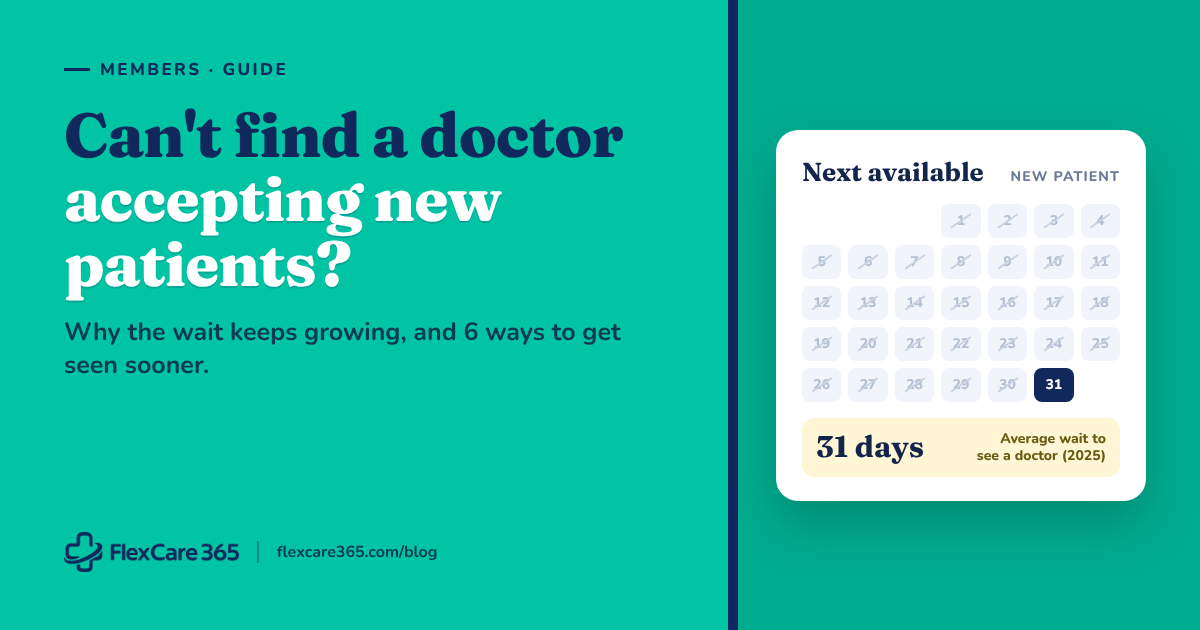
You call the first office on your insurance list. "We're not accepting new patients." You call the next one. Same answer. The third one can fit you in, sometime next month.
If that sounds familiar, it isn't just bad luck. Getting in to see a doctor has been getting harder for years, and the numbers back that up.
How long people are actually waiting
AMN Healthcare's 2025 survey of physician appointment wait times looked at 15 of the largest metro areas in the U.S. The findings:
- The average wait to get an appointment with a doctor is 31 days, up from 26 days in 2022.
- For family medicine specifically, the average wait is 23.5 days.
- In Boston, the average wait across specialties hit 65 days.
That's the average in big cities with lots of doctors. In smaller towns with fewer practices, it can be worse.
And the wait doesn't just annoy people. It stops them getting care. In West Health-Gallup's 2025 State of the States survey, 53% of U.S. adults said long waits for appointments delayed or prevented them from getting care. That made wait times the most common barrier people reported.
Having insurance doesn't fix this. An insurance card gets you on a list. It doesn't get you an appointment.
Why so many doctors aren't taking new patients
A few things are stacking up at once:
- Not enough primary care doctors. Fewer medical graduates choose primary care, and many experienced doctors are retiring.
- Full patient panels. A typical primary care doctor already looks after thousands of patients. Once the schedule is full, the practice closes to new patients to protect care for existing ones.
- Time spent on paperwork. Billing insurance takes a big share of every doctor's week. That's time not spent seeing patients.
None of that is going to change quickly. So the question becomes what you can do now.
6 ways to get seen sooner
1. Ask for the waitlist or cancellation list
When an office says the next opening is weeks away, ask to be added to the cancellation list. Then call back every few days. Spots open up more often than you'd think, and the person who calls tends to get them.
2. Ask for any provider, not one specific doctor
Many practices have nurse practitioners or physician assistants with much shorter waits than the doctors. If what you need is a checkup or a straightforward issue, saying "I'll see whoever is available first" can cut weeks off.
3. Try the health system's central scheduling
Big hospital systems often have a central new-patient line or online booking that shows openings across all their locations. The office down the road might be full while one 20 minutes away has space this week.
4. Don't let the immediate problem wait
If something is bothering you now, don't sit on it until your first appointment. Urgent care or a virtual visit can handle a lot of everyday problems: infections, rashes, minor injuries, refills. Waiting tends to make small problems bigger and more expensive.
5. Check community health centers
If cost is part of the problem, community health centers offer primary care on a sliding scale based on income. Wait times vary, but they're worth a call.
6. Look at a primary care membership
This is the option most people haven't heard of. With a primary care membership, sometimes called direct primary care, you pay a flat monthly fee and get access to a doctor without going through insurance for every visit.
Because the model doesn't depend on insurance billing, it's built around access: shorter waits, longer appointments, and the ability to reach someone when you need care.
How it works with FlexCare 365
FlexCare 365 is a nationwide primary care membership. Here's what members get:
- Same-day or next-day appointments, usually within 48 hours
- Unlimited in-person primary care with board-certified physicians
- Urgent care included
- Virtual visits at $0 on every plan
- Help managing ongoing conditions like blood pressure, diabetes, asthma, thyroid issues and more
- Access in all 50 states, so your care isn't tied to one town
- Low or no visit fees, depending on your plan
Members book through a dedicated care line instead of calling around to find an opening. There's no hunting for a practice that's accepting new patients.
What it doesn't do
We'd rather you know this up front:
- FlexCare 365 is not insurance. It doesn't cover hospital stays, surgery or specialist care. Many members keep an insurance plan for those big-ticket events and use FlexCare 365 for everyday care.
- It's not for an emergency. If you think you're having a medical emergency, call 911.
- Coverage starts on the 1st of the month after you join. If you join on the 20th, your membership is active on the 1st. It's built for ongoing care, not for today's emergency, so it pays to set it up before you need it.
- It's for ages 2 to 65. People on Medicare, Medicaid or Tricare aren't eligible.
Common questions
Why do doctors stop accepting new patients? Their schedule is full. Once a practice can't take on more patients without making existing patients wait longer, it closes to new ones. Some reopen a few spots at a time, which is why waitlists and callbacks are worth it.
Can I see a doctor if I don't have a primary care doctor? Yes. Urgent care and virtual visits don't require you to have a regular doctor. They're great for one-off problems but don't replace ongoing care, especially if you have a condition that needs regular check-ins.
How fast can I see a doctor with FlexCare 365? Once your membership is active, appointments are typically same-day or next-day, usually within 48 hours. Virtual visits are often faster.
Do I need insurance to join? No. You don't need insurance, an insurance card or a Social Security number to join. If you do have insurance, you can keep it. The two work side by side.
Can I get an annual physical? Yes. Members get an annual physical with basic labs after six consecutive months of membership.
Stop waiting to get on someone's schedule
If you've spent weeks trying to get in somewhere, a membership puts you on the schedule instead of the waitlist. See how FlexCare 365 works or see everything that's included.
Join by the end of the month and your membership starts on the 1st.
Sources: AMN Healthcare, 2025 Survey of Physician Appointment Wait Times. West Health-Gallup, State of the States 2025: Insights on Healthcare in America.
FlexCare 365 is a healthcare membership, not insurance. It does not satisfy ACA minimum essential coverage requirements and is not a replacement for insurance.