How Long Does It Take to Get a Doctor's Appointment in 2026?
By Nick English, Co-founder, FlexCare 365 · October 27, 2026
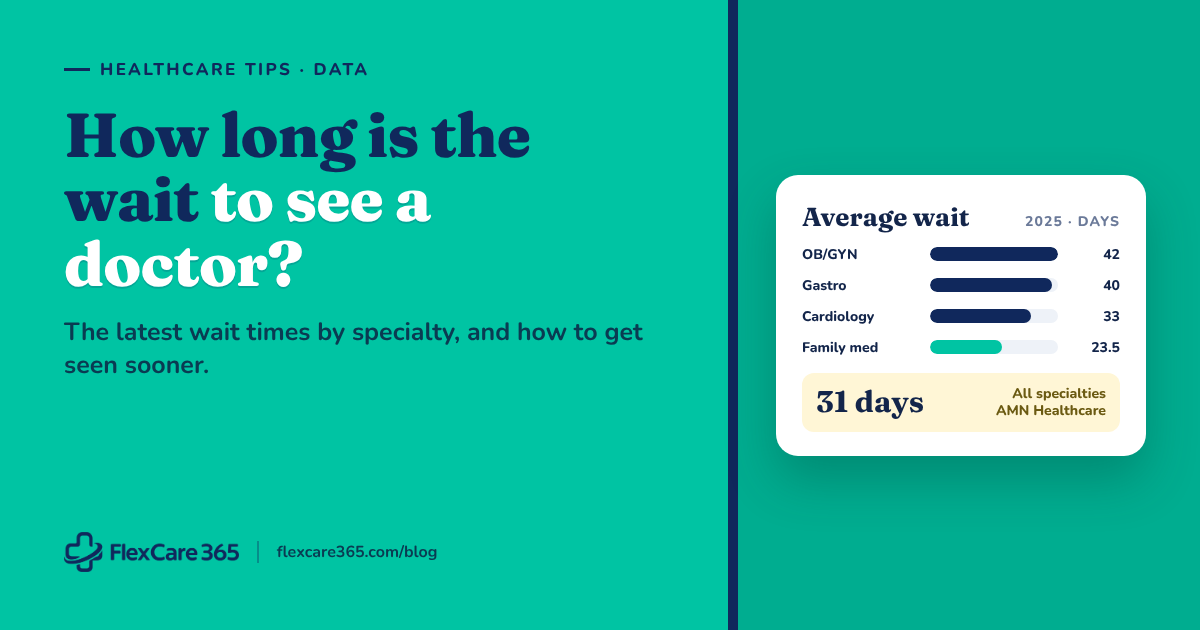
The average wait to get an appointment with a doctor in the U.S. is 31 days, and 23.5 days for family medicine. Wait times have risen 19% since 2022 and are now about 48% longer than when they were first measured in 2004.
These numbers come from AMN Healthcare's 2025 Survey of Physician Appointment Wait Times, the most widely cited study of how long Americans wait to see a doctor. Here's what it found.
Average wait times by specialty
AMN surveyed physician offices in 15 of the largest U.S. metro areas. Average wait for an appointment:
| Specialty | Average wait (2025) |
|---|---|
| Obstetrics and gynecology | 42 days |
| Gastroenterology | 40 days |
| Cardiology | 33 days |
| Family medicine | 23.5 days |
| All specialties combined | 31 days |
Some individual cities were far worse. Boston had the longest average wait across specialties, at 65 days. In Portland, the average wait for a dermatologist was 291 days.
How wait times have changed
| Year | Average wait, all specialties |
|---|---|
| 2004 | 21 days |
| 2022 | 26 days |
| 2025 | 31 days |
That's a steady climb. Family medicine waits alone rose 14% between 2022 and 2025.
Why waits keep getting longer
- Not enough primary care doctors. Fewer new doctors choose primary care, and many experienced physicians are retiring.
- Full schedules. Once a doctor's patient list is full, new patients wait longer or are turned away.
- More time on paperwork. Insurance billing and documentation take time away from seeing patients.
- An aging population. More people need regular care, which means more demand for the same number of appointments.
What long waits do to people's health
Waiting isn't just inconvenient. In West Health-Gallup's 2025 State of the States survey, 53% of U.S. adults said long waits for appointments delayed or prevented them from getting care. It was the most commonly reported barrier to care in the survey.
When people can't get in, problems that could be handled in a 20-minute visit get worse. Some end up at urgent care or the ER, where the same problem costs far more to treat.
How to get seen faster
If you're facing a long wait, a few things help:
- Get on the cancellation list and call back every few days.
- Ask for any available provider, including nurse practitioners and physician assistants.
- Use virtual visits for straightforward issues.
- Look at a primary care membership, which is built around short waits.
We go through each of these in detail in what to do when you can't find a doctor accepting new patients.
How FlexCare 365 handles wait times
FlexCare 365 is a nationwide primary care membership. Once your membership is active:
- Appointments are same-day or next-day, usually within 48 hours
- Virtual visits are $0 on every plan and often faster still
- You book through a dedicated care line, so there's no calling around to find an office with an opening
- Your membership works in all 50 states
It's a membership, not insurance. It covers primary care, urgent care and virtual visits, not hospital or specialist care. Coverage starts on the 1st of the month after you join.
Common questions
What's the average wait to see a doctor in 2026? The most recent large survey, from AMN Healthcare in 2025, found an average of 31 days across specialties and 23.5 days for family medicine in major metro areas.
Which specialty has the longest wait? In AMN's 2025 survey, obstetrics and gynecology had the longest average wait at 42 days, followed by gastroenterology at 40 days.
Are wait times longer in some cities? Yes. Boston had the longest average wait of the cities surveyed, at 65 days across specialties.
How can I see a doctor faster? Waitlists, seeing any available provider, virtual visits and primary care memberships all help. A membership like FlexCare 365 offers same-day or next-day appointments once you're a member.
Skip the wait next time
If your next appointment is a month out, there's a faster way to get everyday care. See how FlexCare 365 works.
Join by the end of the month and your membership starts on the 1st.
Sources: AMN Healthcare, 2025 Survey of Physician Appointment Wait Times. West Health-Gallup, State of the States 2025: Insights on Healthcare in America.
FlexCare 365 is a healthcare membership, not insurance. It does not satisfy ACA minimum essential coverage requirements and is not a replacement for insurance.