High Deductible? How to See a Doctor Without Paying Full Price Every Visit
FlexCare 365 Team · October 20, 2026
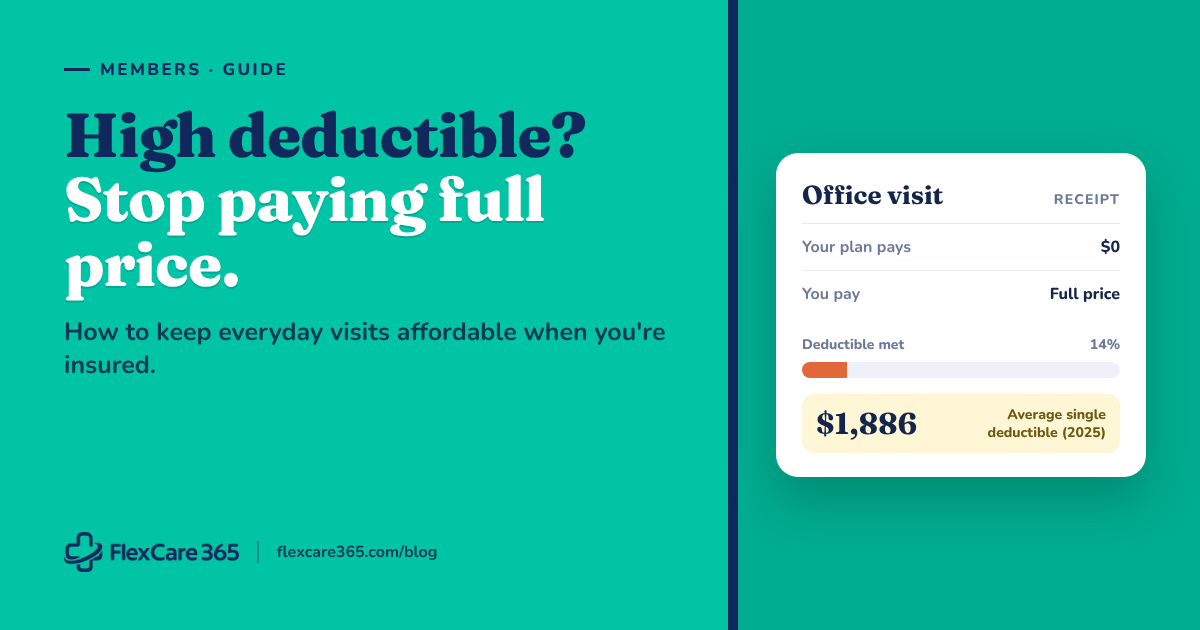
If you have a high-deductible plan, you usually pay the full price of a doctor visit until you've spent enough to meet your deductible. The simplest fix is to separate everyday care from your insurance, so routine visits cost a flat, predictable amount and your insurance stays in place for the big things.
Here's how that works, and why so many people with insurance still avoid the doctor.
Why you're paying full price when you have insurance
A deductible is the amount you pay for care each year before your insurance starts sharing the cost. Until you reach it, most visits come out of your pocket at the price your insurer negotiated.
Preventive care like an annual physical is often covered without a deductible. But a sick visit, a follow-up, or a check-in on your blood pressure usually isn't. Those count toward the deductible, which means you pay for them.
And deductibles aren't small:
- The average deductible for single coverage through an employer is $1,886 a year, according to KFF's 2025 Employer Health Benefits Survey.
- 34% of covered workers have a deductible of $2,000 or more.
- Plans that qualify as high-deductible must have a deductible of at least $1,700 for single coverage in 2026.
So if you see a doctor three or four times in a year, you may pay for every one of those visits in full and never reach your deductible at all. Your insurance is there in theory. In practice, you're paying cash.
What that does to how people use care
When every visit comes with a bill, people wait. According to KFF, about three in ten adults ages 18 to 64 who have insurance say they didn't get health care they needed in the past year because of the cost.
That's not a small group of people gaming the system. It's people with coverage deciding a sore throat, a rash or a follow-up isn't worth the bill. Some of those problems get better on their own. Some turn into urgent care or ER visits that cost far more.
4 ways to keep everyday care affordable on a high deductible
1. Use what's already covered at no cost
Check which preventive services your plan covers without a deductible. Annual physicals, many screenings and vaccines are often included. Book those, even if you feel fine.
2. Ask for the cash price
Some practices offer a self-pay price that's lower than what your insurer has negotiated. If you know you won't meet your deductible this year, it can be worth asking, "What's your price if I pay directly?"
3. Use virtual visits for simple issues
Many insurers and employers include virtual visits at a lower cost than in-person care. For a cold, a rash or a prescription refill, a video visit can be enough.
4. Add a primary care membership for everyday care
This is the option that changes the math the most. With a primary care membership, sometimes called direct primary care or a doctor subscription, you pay a flat monthly fee for primary care. Your visits don't go through insurance, so they don't hit your deductible.
You keep your insurance for what it's best at: hospital stays, surgery, specialists and other big, unexpected costs. The membership covers the everyday visits that would otherwise come out of your pocket one bill at a time.
How it works with FlexCare 365
FlexCare 365 is a nationwide primary care membership that works alongside your insurance. Members get:
- Unlimited in-person primary care with board-certified physicians
- Urgent care included
- Virtual visits at $0 on every plan
- Same-day or next-day appointments, usually within 48 hours
- Help managing 13 ongoing conditions, including blood pressure, diabetes, asthma, anxiety and thyroid disorders
- A $0 list of common short-term medications like antibiotics and cough and pain relief, plus $5 prices on a list of 200 long-term medications (not available in Maine or Washington)
- Low or no visit fees, depending on your plan
Because FlexCare 365 doesn't bill your insurance, nothing counts toward your deductible and there's no surprise bill after a visit. You know what everyday care costs before the month starts.
If you're also struggling to get an appointment at all, here's what to do when doctors aren't accepting new patients.
What it doesn't do
- It isn't insurance, and it doesn't replace it. Keep your plan for hospital care, surgery and specialists.
- It doesn't count toward your deductible. Membership fees are separate from your insurance costs.
- Coverage starts on the 1st of the month after you join.
- It's for ages 2 to 65. People on Medicare, Medicaid or Tricare aren't eligible.
Common questions
Why do I pay full price for a doctor visit when I have insurance? Because you haven't met your deductible yet. Until you do, most non-preventive visits are paid by you at your insurer's negotiated rate.
Is a high-deductible plan a bad choice? Not necessarily. Lower premiums can make sense, especially if you rarely need care. The problem is that everyday visits become expensive. Pairing a high-deductible plan with a membership for primary care is one way to keep the low premium without paying full price every time you see a doctor.
Does a primary care membership count toward my deductible? No. It's separate from your insurance. The upside is that your everyday visits don't need to go through insurance at all.
Can I keep my current doctor? You can keep your insurance and any doctors you see through it. FlexCare 365 gives you access to its own nationwide network of physicians for everyday care.
Stop paying full price every visit
If your deductible is the reason you put off seeing a doctor, a flat monthly fee takes that decision off the table. See everything that's included or see how FlexCare 365 works.
Join by the end of the month and your membership starts on the 1st.
Sources: KFF, 2025 Employer Health Benefits Survey. KFF, Americans' Challenges with Health Care Costs (May 2026). IRS 2026 high-deductible health plan limits.
FlexCare 365 is a healthcare membership, not insurance. It does not satisfy ACA minimum essential coverage requirements and is not a replacement for insurance.