Direct Primary Care vs Health Insurance: What Each One Actually Covers
By Nick English, Co-founder, FlexCare 365 · October 22, 2026
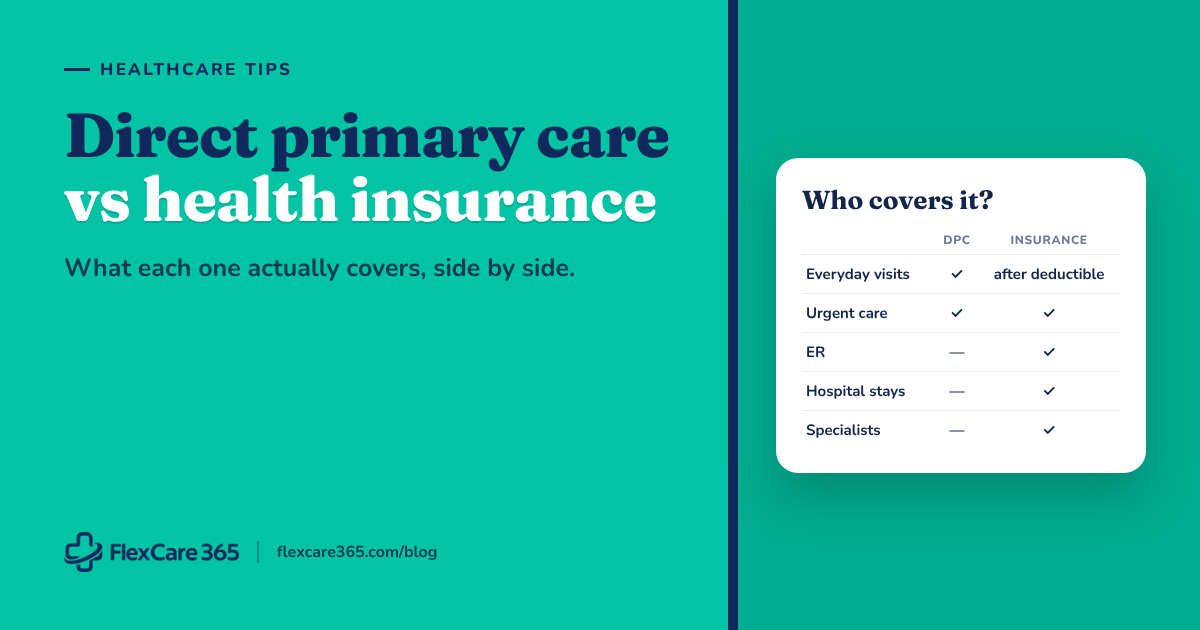
Direct primary care covers everyday doctor visits for a flat monthly fee. Health insurance covers large, unexpected costs like hospital stays, surgery and specialist care. They solve different problems, which is why many people use both.
Here's how they compare side by side, and how to tell which one you need.
The short version
Direct primary care is a membership. You pay a monthly fee and get access to primary care: checkups, sick visits, follow-ups and help managing ongoing conditions. There's no claim and no deductible for those visits.
Health insurance is financial protection. You pay a premium, then share costs through deductibles, copays and coinsurance. It's built for the expensive, unpredictable events: an ER visit, a hospital stay, surgery, cancer treatment.
Side by side
| Direct primary care | Health insurance | |
|---|---|---|
| What you pay | A flat monthly fee | A monthly premium, plus deductibles, copays and coinsurance |
| Everyday doctor visits | Included in the fee | Often full price until you meet your deductible |
| Wait for an appointment | Usually short. Built around access | Depends on the doctor. Averages around a month in big cities |
| Urgent care | Included in some memberships | Covered, usually with a copay or after the deductible |
| Emergency room | Not covered | Covered |
| Hospital stays and surgery | Not covered | Covered |
| Specialists | Not covered | Covered, often with a referral |
| Prescriptions | Some memberships include discounts or low-cost lists | Covered under your plan's drug list |
| Surprise bills | No. You know the cost up front | Possible, depending on the care and the network |
| Counts as coverage under the ACA | No | Yes |
Where each one falls short
Insurance alone leaves a gap in everyday care. With an average single-coverage deductible of $1,886 for employer plans (KFF, 2025), routine visits often come straight out of your pocket. That's why so many insured people put off seeing a doctor. We covered that in more detail in how to see a doctor on a high deductible without paying full price.
Direct primary care alone leaves you exposed to big bills. A membership won't pay for an ER visit, a hospital stay or a broken leg that needs surgery. If something serious happens, you'd be paying those costs yourself.
Which one do you need?
Insurance is the priority if you:
- Have a condition that needs specialist or hospital care
- Are pregnant or planning to be
- Want protection against a major accident or illness
Direct primary care is a strong add-on if you:
- Have a high deductible and pay full price for regular visits
- Can't get an appointment without waiting weeks
- Have an ongoing condition that needs regular check-ins
- Are self-employed and want predictable costs for routine care
For most people, the answer is both. A lower-premium insurance plan protects you from the big costs. A membership handles the everyday visits so you're not paying a bill every time you see a doctor.
How FlexCare 365 fits
FlexCare 365 is a nationwide primary care membership. It's designed to sit alongside insurance, not replace it. Members get:
- Unlimited in-person primary care with board-certified physicians
- Urgent care included
- Virtual visits at $0 on every plan
- Same-day or next-day appointments, usually within 48 hours
- Help managing 13 ongoing conditions
- Access in all 50 states
- Low or no visit fees, depending on your plan
If you're new to the idea, here's how doctor subscriptions work in general.
Common questions
Is direct primary care insurance? No. It's a membership for primary care. It doesn't cover hospital stays, surgery, specialists or emergencies, and it doesn't count as health coverage under the Affordable Care Act.
Can I have direct primary care and health insurance at the same time? Yes. That's how most members use it. Insurance covers the big events and the membership covers everyday care.
Is direct primary care cheaper than insurance? The monthly fee is usually lower than an insurance premium, but they don't cover the same things. Compare what you actually spend on everyday care now, including visits you pay for before your deductible, against the membership fee.
Does direct primary care count toward my deductible? No. Your membership is separate from your insurance.
See how it fits with your plan
If your insurance covers the big stuff but everyday care still costs too much or takes too long to get, a membership fills that gap. See what's included or see how FlexCare 365 works.
Join by the end of the month and your membership starts on the 1st.
Sources: KFF, 2025 Employer Health Benefits Survey. AMN Healthcare, 2025 Survey of Physician Appointment Wait Times.
FlexCare 365 is a healthcare membership, not insurance. It does not satisfy ACA minimum essential coverage requirements and is not a replacement for insurance.