Urgent Care vs ER: When to Go and What Each Costs
By Nick English, Co-founder, FlexCare 365 · October 29, 2026
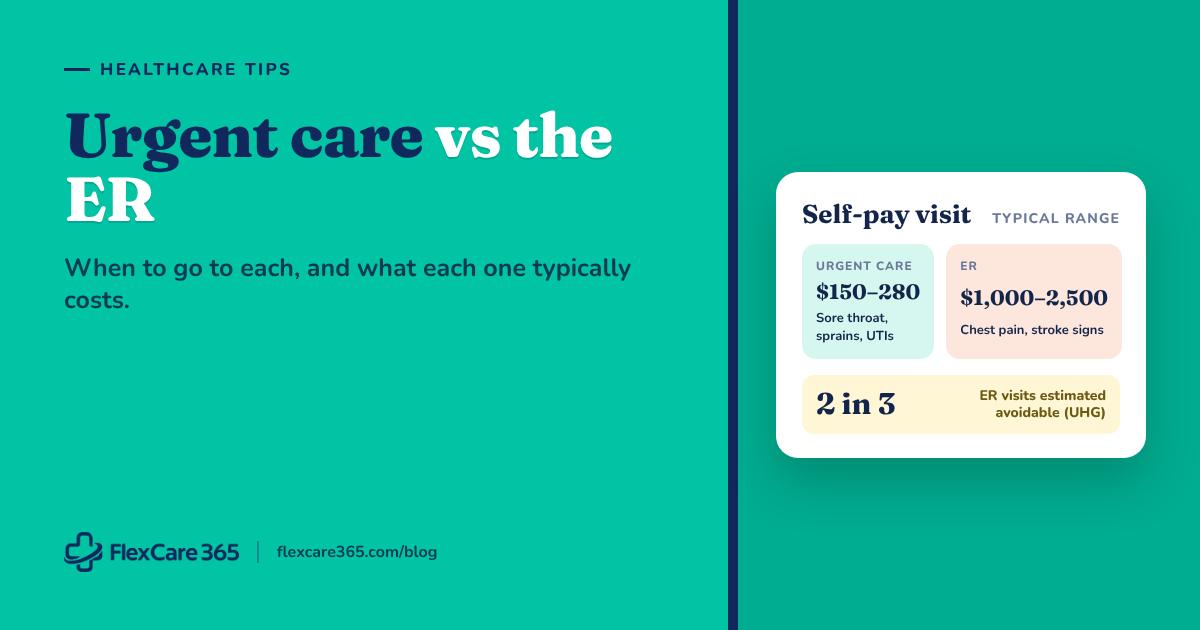
Go to the ER for anything that could be life-threatening: chest pain, trouble breathing, signs of a stroke, severe bleeding or a serious injury. For everything else that can't wait for a regular appointment, like a sore throat, a sprain, a fever or a minor cut, urgent care is usually faster and costs far less.
Here's how to tell the difference, and what each one typically costs.
Side by side
| Urgent care | Emergency room | |
|---|---|---|
| Best for | Illnesses and injuries that need care today but aren't life-threatening | Life-threatening or severe emergencies |
| Common reasons | Colds, flu, sore throat, ear infections, UTIs, sprains, minor cuts, rashes | Chest pain, trouble breathing, stroke signs, severe bleeding, broken bones, head injuries |
| Typical wait | Usually shorter | Can be hours for non-urgent cases, because the sickest patients are seen first |
| Typical self-pay cost | About $150 to $280 for a standard visit | About $1,000 to $2,500 for common conditions, without insurance |
| Open | Extended hours, most days | 24/7 |
| Equipment | Basic tests, often X-rays | Full hospital resources |
Self-pay ranges from Solv's 2026 price guide. Your cost will vary by location, the care you need and your insurance.
Call 911 or go to the ER for
- Chest pain or pressure
- Trouble breathing
- Signs of a stroke: face drooping, arm weakness, slurred speech
- Severe bleeding that won't stop
- A head injury with confusion or loss of consciousness
- Seizures
- Severe burns
- A suspected broken bone that's out of place
- Sudden, severe pain
If you're not sure whether it's an emergency, treat it as one.
Urgent care or your regular doctor is usually fine for
- Cold, flu and COVID symptoms without trouble breathing
- Sore throat or ear pain
- Urinary tract infections
- Sprains and strains
- Minor cuts that may need stitches
- Rashes and minor allergic reactions
- Mild fever
The real cost of using the ER for minor problems
A UnitedHealth Group analysis estimated that about two-thirds of ER visits by people with private insurance were avoidable, meaning they could have been treated in a doctor's office or at urgent care.
The cost difference was large. Treating common, minor conditions averaged $2,032 in the ER, compared with $193 at urgent care and $167 at a doctor's office. Those figures are from 2018 data, so today's prices are likely higher across the board, but the gap is the point.
Why people end up in the ER anyway
Most people don't choose the ER for a sore throat because they think it's the best option. They go because:
- They couldn't get an appointment with a doctor
- It was after hours
- They waited until a small problem became a big one, often because of the cost of seeing a doctor sooner
That last one is common. When every doctor visit means a bill, people put it off. We looked at how long people wait for appointments in doctor appointment wait times in 2026, and why insured people still skip care in seeing a doctor on a high deductible.
How a membership helps you avoid the ER
The easiest way to stay out of the ER for minor problems is to have somewhere faster and cheaper to go first. That's what a primary care membership is for.
FlexCare 365 members get:
- Urgent care included
- Unlimited in-person primary care
- Virtual visits at $0, which are often the quickest way to find out whether you need to be seen in person
- Same-day or next-day appointments, usually within 48 hours
- Low or no visit fees, depending on your plan
Appointments are booked through a dedicated care line rather than walk-in, so they're best for problems that can wait a few hours to a day. For anything that feels like an emergency, call 911.
FlexCare 365 is a membership, not insurance. It doesn't cover ER visits or hospital care, which is why many members keep an insurance plan for emergencies.
Common questions
Is urgent care cheaper than the ER? Yes, usually by a lot. Self-pay urgent care visits typically run about $150 to $280, while an uninsured ER visit for a common condition can be $1,000 to $2,500 or more.
Can urgent care do X-rays and stitches? Many urgent care centers can. Call ahead or check online if you're not sure.
When should I skip urgent care and go straight to the ER? For chest pain, trouble breathing, stroke signs, severe bleeding, a serious head injury or anything you think could be life-threatening.
Can a virtual visit help me decide where to go? Often, yes. A doctor can tell you whether your symptoms need in-person care, urgent care or the ER.
Have a plan before you need it
The best time to figure out where to go is before something happens. See how FlexCare 365 works.
Join by the end of the month and your membership starts on the 1st.
Sources: Solv, How Much Does Urgent Care Cost Without Insurance in 2026. UnitedHealth Group, The High Cost of Avoidable Hospital Emergency Department Visits (2019, using 2018 data).
FlexCare 365 is a healthcare membership, not insurance. It does not satisfy ACA minimum essential coverage requirements and is not a replacement for insurance. If you think you are having a medical emergency, call 911.